Jelling Tourist Information
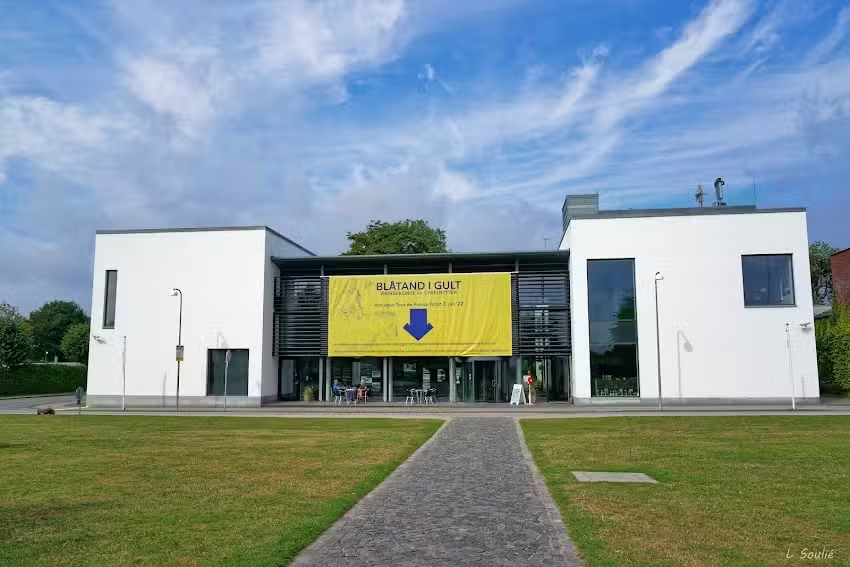
BackJelling Tourist Information is a compact, local tourist office that serves as a convenient hub for visitors who want an overview, brochures and personal help to plan their stay in the area. The office is centrally located on Gormsgade, and many guests use it as their first stop to get an idea of which activities, sights and experiences make the most sense in terms of time, budget and travel style.
Although Jelling Tourist Information is not a large commercial player, it offers the basic services you would expect from a classic tourist office : a staffed counter, printed maps, inspiration for routes and suggestions for cultural and nature activities. Here, travelers can get help putting together a daily schedule or a shorter stay, and especially for guests who do not want to do everything digitally, the personal contact is a great advantage. The office also functions as an external face for the local area, where the employees' local knowledge is often more important than advanced digital systems.
For visitors looking for structure in their trip, Jelling Tourist Information can be a good complement to online planning tools. While many international guests are used to using large online travel agencies and search engines to book flights, hotels and car rentals, the tourist office can help with the last step: getting concrete suggestions on what to actually spend your time on once you have arrived. Local knowledge about distances, transport options and seasonal events can be crucial to whether a short stay is experienced as well-organized or fragmented.
A common advantage of Jelling Tourist Information is the direct access to people who know the area intimately. Many travelers emphasize that they get answers to very practical questions that digital platforms cannot always handle accurately: how long it actually takes to walk between attractions, how is the accessibility for strollers or people with walking difficulties, and which times of day are quietest if you want to avoid the largest groups. This individual guidance is a strength compared to larger, standardized travel agencies, where contact is often via forms or call centers.
The physical layout of the tourist information is typically described as simple and functional. There are typically shelves with brochures in several languages, maps of the area and materials about both local attractions and regional excursion options. It is not a place that you visit for the atmosphere in itself, but rather a service point where you can quickly get the information you need. For some guests it seems a bit traditional compared to the more experience-oriented centers that some larger destinations offer, but for others it is an advantage that the focus is on information rather than entertainment.
Compared to larger international travel agencies and commercial players, Jelling Tourist Information is naturally limited in what it can help with. The office is not a full-scale tour operator that tailors package tours with flights, hotels and transport across countries; it is primarily a local information point. Travelers who expect to be able to arrange complex bookings on the spot may therefore find that the service does not match the options they know from large online platforms. Here it is important to see the tourist information as a supplement to, not a replacement for, the digital solutions that many people already use before they arrive.
Another limitation is that much of the communication and material is naturally aimed at guests who understand Danish or English. Many staff are used to international visitors, but the range of brochures and written information in less widely spoken languages can be limited. In an era where travel planning is often done in native languages via the internet, this can be seen as a disadvantage for some segments, especially if travelling with older family members who are less comfortable in English.
On the positive side, many people find that the tourist information gives a good first-hand impression of the area and makes it easier to get an overview, especially if you arrive without a detailed plan. It is often pointed out that the employees are welcoming and helpful, and that they are happy to spend time listening to the guests' wishes. For travelers who prioritize personal dialogue over using apps exclusively, this can make a clear difference to the experience. For many, the personal recommendation weighs more heavily than anonymous online reviews.
For families with children, Jelling Tourist Information can be a practical place to start the day, because you can quickly get a comprehensive overview of activities that are realistic with children. Here, playgrounds, short walks, child-friendly museums and practical details can often be pointed out, which are not always clearly visible in the major international search engines. For more experienced travelers, who use online travel agencies to put together transport and accommodation themselves, the tourist information can instead be the place to fine-tune the program and find the small local experiences that do not dominate in global searches.
On the other hand, some travelers will find that the need for physical tourist information has generally decreased because so much can be found online. Compared to the largest digital players in the tourist agency and travel agency industry, a local office naturally offers fewer digital services, and there may be limited opportunity for real-time updates on everything from capacity on experiences to current changes. The traveler who is used to full, app-based management of their trip may therefore experience the tourist office as an extra link that does not always feel necessary.
There is also an expectation among some guests that a modern tourist office will support digital tools to a greater extent, such as QR codes for routes, mobile maps or integration with major travel portals. When this is not fully the case, it can seem a bit old-fashioned, although the human service compensates for some of it. The difference becomes clear when compared to global solutions, where algorithms and data play a large role in predicting what users want.
For potential visitors considering using Jelling Tourist Information, it is therefore relevant to think about your own type of travel. If you are comfortable using large online travel agencies to arrange everything in advance and simply want to follow a fixed plan, you may be able to make do with digital sources. On the other hand, if you value being able to ask questions, get local perspectives and adjust your stay according to the weather, your mood or interests, the tourist office has a clear role. Here you can get suggestions for alternative experiences if something unexpected arises.
Jelling Tourist Information also acts as a link between visitors and other local actors, whether it is cultural institutions, accommodations, restaurants or organizers of small, local activities. This role is important because smaller businesses in the area are not necessarily visible on international travel portals and search services. Guests looking for more authentic or less commercial experiences therefore have an advantage by asking at the tourist office, where they will receive recommendations that are not solely based on large advertising budgets or algorithms.
In terms of service, the experience is generally positive, but depending on the time of day and season, some guests may experience busyness or short wait times. During peak season, there may be more visitors at the same time, and although staff typically try to help everyone, this can mean that each individual gets a little less time than they might have hoped. Compared to digital services that are available 24/7, this is a natural limitation of a physical service, but for many it is outweighed by the quality of the dialogue you actually get when it is your turn.
Overall, Jelling Tourist Information stands out as a solid local hub that complements, but does not replace, the large digital travel portals and international travel agencies . The strengths lie in proximity, local knowledge and the ability to customize the stay to personal wishes, while the weaknesses are primarily limited digital integration and the natural framework for how much they can help with when it comes to international bookings. For travelers who value personal service and genuine local knowledge, a visit to Jelling Tourist Information can be an important element in getting the most out of their stay.