The County Governor’s Residence
BackThe county governor's residence on Østergade in Hjørring today appears as a unique combination of historic official residence and modern business environment, where, among other things, a small travel agency and service function is attached to the building. The building was designed in 1910 by the architect Hack Kampmann and is listed as a single building with an associated garden, which gives the setting a distinctive atmosphere that differs from many newer office environments. For potential customers seeking personal advice and peace of mind when planning trips, the historic environment can be part of the experience, but it also means that one should not expect a large, modern store concept with lots of digital self-service solutions.
As a registered travel agency and property entity, Amtmandsboligen is categorized as both a mortgage and travel agent, reflecting that it is typically a smaller entity with an office feel rather than a high-profile retail agency. This often allows for close contact with the employees who work in the house, and for customers it can mean more time to discuss wishes, special needs and complex holiday plans face to face. The downside is that opening hours and availability can be more limited compared to the largest chains, and that spontaneous inquiries do not always fit into a busy everyday life.
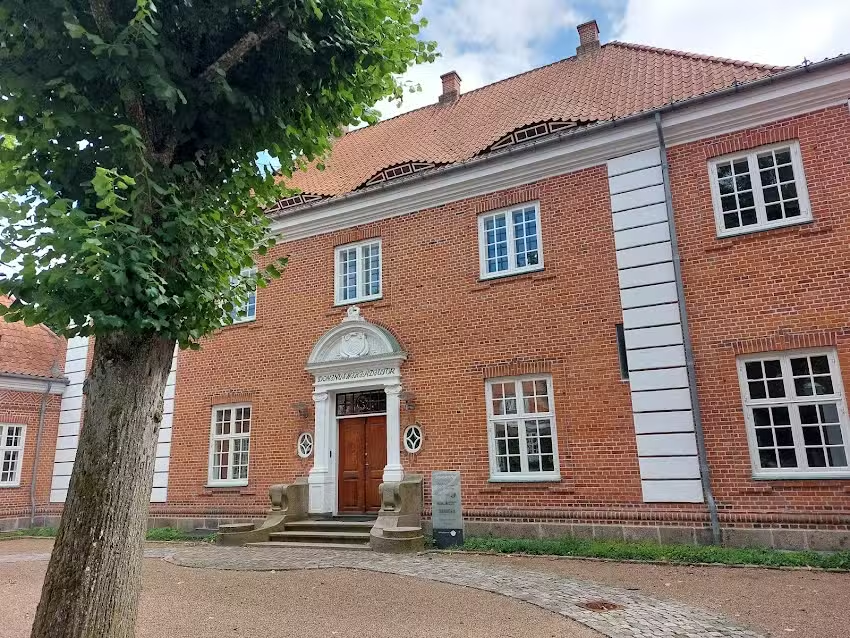
The architectural expression means that the visit can feel more like a visit to a culturally historic building than to a classic travel sales point. The county governor's residence is built in a neoclassical style with blank walls, granite and a red tiled roof, and the house has been extensively restored to an expression that is close to the original. For a potential travel customer, this can create a certain expectation of seriousness and stability, because the surroundings signal tradition, anchoring and care. Conversely, it can also mean that there is not the same visible, modern marketing, large windows and campaign posters that are often encountered with more commercial players.
The building currently has a semi-public function and is rented out to the municipality, while the garden functions as a small park open to the city's citizens. This means that some of the activity in and around the building is not necessarily directly related to travel services, but also to administration, meetings and other municipal functions. For customers who seek out a local tourism business with the expectation of high visibility, it may require a little extra preparation to find out exactly where in the building the relevant unit is located.
On the positive side, the environment in the Amtmandsboligen provides a special calm for talking about travel, vacation plans and longer stays, because you are not in a noisy store environment with a lot of traffic. Some customers appreciate being able to sit down in quiet surroundings and go over details about transportation, accommodation and activities with an employee who works in a more classic office setting. Others may miss the lively atmosphere, large catalog walls and many promotional offers that often characterize larger chain-based travel agencies .
The publicly available data shows only a small number of reviews, which suggests that the site does not aggressively market itself as a large consumer-oriented holiday shop. The few ratings that do exist are generally high, indicating satisfied users, but the number is too low to speak of a broad experience base. This can be interpreted as meaning that you as a customer get a more personal, but also more niche service, where the company does not necessarily cater to mass tourism.
The County Councillor's residence's affiliation with Realdania By & Byg and the house's status as part of a collection of historic properties means that there is a strong focus on maintenance, quality and sustainability. The property has a relatively low CO2 emission per square meter over 50 years, which may be interesting for climate-conscious customers who want to support operators who work in energy-efficient environments. The travel activities themselves are of course not directly tied to the building's energy consumption, but for some, the overall narrative of responsibility and respect for architectural heritage may play a role when assessing who they want to do business with.
The garden around the Amtmandsboligen contains a gazebo, a pergola with ivy and a small plant in front of the house, which provides a visually strong expression and a pleasant access route for visitors. For customers who meet in person, it can be an extra quality to be able to arrive through green surroundings, possibly sit outside before or after a meeting and have time to consider travel plans in peace. However, this can also mean that the access conditions are not necessarily designed for quick in and out, as one would expect in a modern shopping center, and that one has to allocate a little extra time for parking and walking to the entrance.
As a tour operator -related player based in a listed building, Amtmandsboligen stands out from many more standardised offices built exclusively for commercial use. Some customers will find this to be a clear strength, as it gives a sense of seriousness, history and care that can be transferred to the way trips are planned and handled. Others may miss the more visible markers of a modern travel brand, such as digital screens, open lobby areas and clear signage, and will feel that it takes a little extra effort to find your way around.
An important factor is that the Amtmandsboligen does not appear as a pure business facade for a single private actor, but rather as a framework that can house several functions – including travel-related services, municipal activities and cultural-historical dissemination. For the customer, this means that you get access to an actor that is anchored in a stable, institutional environment, but on the other hand, the flexibility in terms of opening hours, front-line staff and spontaneous visits may be more limited. At the same time, the expectation will typically be that you book an appointment or clarify in advance how the contact will take place, instead of simply showing up.
For those who value personal contact and peace in the decision-making process, Amtmandsboligen can be an attractive choice when arranging holidays, stays or other travel arrangements through a smaller, locally based tourist service . The historical setting, the well-maintained garden and the connection to a larger building culture portfolio support an impression of care and responsibility. For others who are looking for a very wide selection of charter trips, package deals and globally marketed concept trips, the largest nationwide chains will often be more obvious, because they are more clearly profiled as consumer-oriented travel shops.
Overall, the Amtmandsboligen offers an environment where serious surroundings and cultural history form the framework for modern service functions, including travel-related advice on a smaller scale. The strengths lie in the calm atmosphere, the physical quality and the institutional anchoring, while the challenges are mainly limited visibility, few public reviews and a focus that is not uniquely directed towards classic holiday sales. For potential customers looking for a locally anchored alternative to the large, nationwide travel agencies, the Amtmandsboligen may be worth considering, as long as one is aware that the house has multiple purposes and that the travel function is one part of a larger whole.